Unedited footage. At the Chrystal Palace, in Oporto, an automobiles exhibition. Panoramic view of the city. The car stands.
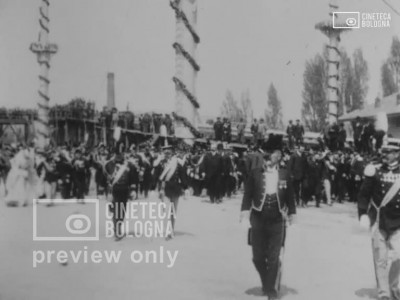
Panoramic shot over Santiago de Compostela. A crowd in the streets attends a procession followed by a parade of men with hats, women with veils, people with masks and music bands.
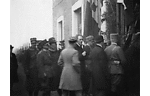
Unedited footage on the Presidential visit to Oporto on the occasion of the 31st January celebrations (1st attempt of a republican revolution)
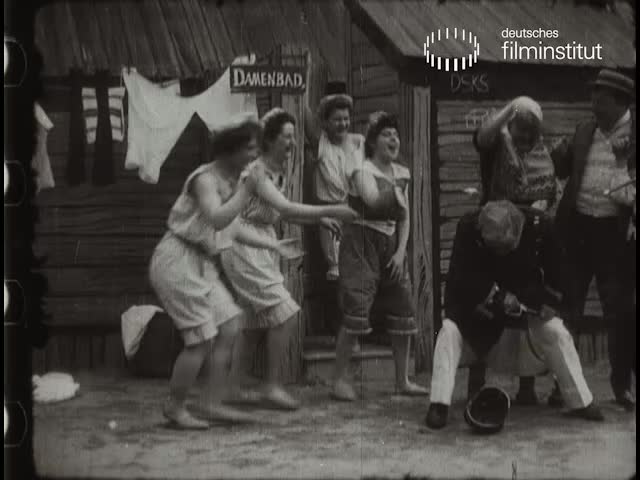
Bei "Vor dem Damenbad" handelt es sich um ein Tonbild. Tonbild ist eine Bezeichnung für frühe Kinofilme mit Synchronton (aufgezeichnet und abgespielt im Nadeltonverfahren). In Deutschland begann die...
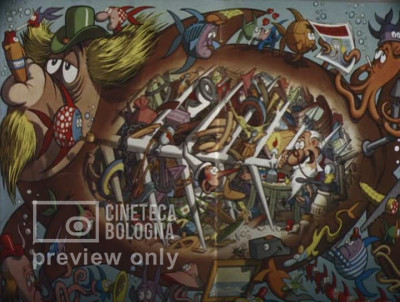
A re-examination of the text based on illustrations of various editions of “Pinocchio” by Carlo Collodi.
Episode of the series "Aviation in Brescia": airplane exercises featuring the pilots Curtiss, Rougier, Calderara, Blériot and Cobianchi.
Film restored in collaboration with Fondazione Cineteca Italiana.
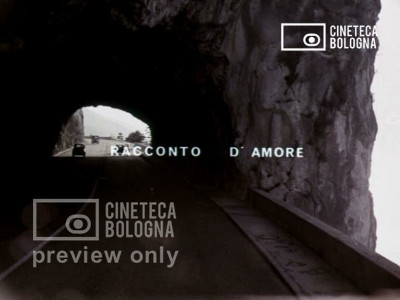
This documentary puts together different moments of Pier Antonio Quarantotto Gambini’s poetic journey, pausing on the only work in verse by this writer from Trieste, “Racconto d'amore” (Lo...
American soldiers sent to France march with the American flags in the streets of Paris.
Mobilization in Germany. German soldiers wave from the windows of the train before leaving for the front.
Czechoslovak volunteers on a small station in Siberia.
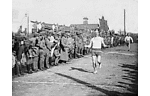
Czechoslovak volunteers relax - a run competition.
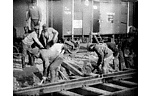
Technical troops maintained in good repair railway tracks - covering the underside of rails.
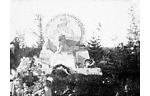
A monument with a stone lion - a symbol of Czech statehood- on the grave of fallen volunteers.
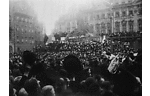
Welcome of the President T.G. Masaryk after his arrival in the country. On the monument of Jan Hus is a banner with the slogan "People of Jan Hus".
Tomáš Garrigue Masaryk met the king of Italy Vittorio Emanuele III. di Savoia in Batavia.
Das Königliche Bild-und Filmamt und die Industrie, Der Kinematograph, 571, (1917). S. 22ff. Artikel über Verhandlungen des Bild-und Filmamtes mit Vertretern der Filmindustrie. Bufa zeige sich am Woh...
Walter Thielemann, Der Film 1917, Der Kinematograph, 573, (1917), S. 12ff. Jahresrückblick. Positiv hervorgehoben wird die immer breitere Anerkennung, die dem Kino zuteil werde, da der immer mehr sei...
Scala-Film-Verleih GmbH, Der Hetman der Ukraine, Der Kinematograph, 581, (1918), S. 18-19. Die Anzeige geht auf den Sieg gegen Russland ein und erwähnt das Interesse des Publikums an der Geschichte d...
Argus, Neuheiten auf dem Berliner Filmmarkte, Der Kinematograph, 581, (1918), S. 28-29. "Edelsteine" wird als erstes besprochen und als psychologisch tiefgründiges Werk bezeichnet. An dritter Stelle ...
Argus, Der rasende Roland von Euskirchen, Der Kinematograph, 582, (1918), S. 6. Entgegnung auf Vorwürfe des Euskirchener Volksblattes, das Kino sei sittenverderbend. Der Schriftleiter Werner Rats kö...
Argus, Neuheiten auf dem Berliner Filmmarkte, Der Kinematograph, 586, (1918), S. 28ff. Besprochen werden gleich zwei Propagandafilme zur achten Kriegsanleihe. "Lloyd George in Berlin" wird als äußer...
Julius Sternheim, Propaganda-und Aufklärungsfilme, Der Kinematograph, 592, (1918), S. 12-14. Propagandafilme müssten maßgeblich eine Botschaft verfolgen, was sie oftmals zwangsläufig langatmig mac...
Ludwig Brauner, Die kommende Geschmackswandlung, Der Kinematograph, 593, (1918), S. 15-16. Erörterung des Publikumsgeschmacks. Gegenwärtig sei vor allem Ablenkung vom Kriegsalltag gefragt, jedoch li...