(Reel 1) Near Bapaume a German "anti-tank gun" lies in an unidentifiable wreck with its crew dead beside it. Shells burst in the distance. Two 6-inch Mk VII guns are drawn by Holt tractors to new posi...
(Reel 1) Most of the scenes are of Indian troops of 15th Cavalry Brigade, 5th Cavalry Division. Also shown in the advance are the Nottinghamshire Battery, Royal Horse Artillery and 'A' Battery of the ...
I. The film is outspoken, "The evidence - both documentary and otherwise - is now ample to prove that Germany forced this great and terrible War upon humanity to secure for herself the domination of t...
I. The film is often disjointed, but covers the transfer of American manpower and matériel across the Atlantic, culminating in their first major engagement in the Battle of Château-Thierry in June 1...
(Reel 1) Albert Cathedral, mid-1916. The Canadian 6th Brigade, 2nd Division, led by Brigadier-General H D B Ketchen (past German prisoners) towards the battlefield, halts to rest at La Boisselle cross...
I. Captain Paul Daum, commanding the French 28ième Escadrille, attached to 79th Division, posed in his Salmson 2A2 aircraft at Rumont on 18th October. A posed group of officers of the escadrille. Lef...
The "Deuxième Bataille Offensive de Verdun" opens with a bombardment. A 145mm naval gun firing under tarpaulin, showing its loading mechanism clearly. Other guns join in - a 155mm heavy howitzer, a 7...
The Prince talks with French staff officers in a snowbound wood. Getting out of his car at another location he walks into a wood with his party. The group poses for the camera.The French troops have s...
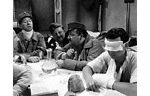
Medium shot of several men sitting around a table with a half loaf of bread and a carafe of water. On the left sits Sakař (actor: Jindřich Plachta) with a bandaged neck. To the right sit Vyskočil (...
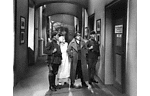
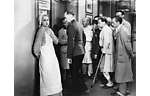
Wide shot of a corridor. Standing in front of the door to Dr. Šrámek's office are Nurse Mathilde (actress: Adina Mandlová) and Rjepkin (actor: Vladimír Borský) flanked by Austrian military guards...
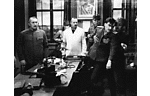
View of an office. A colonel of the Austrian army (actor: Jaroslav Marvan) and Dr. Šrámek (actor: František Smolík) are standing at a desk. Behind Šrámek are two military guards (on the right, a...
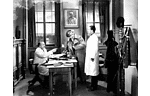
Wide shot of an office. Dr. Šrámek (actor: František Smolík) is sitting at a desk and pointing at another doctor standing on the opposite side of the desk. Rjepkin (actor: Vladimír Borský) is st...
Wide shot of a corridor and a door with a sign indicating "MUDr. Fr. Šrámek." Standing in front of the door are nurse Mathilde (actress: Adina Mandlová), First Lieutenant Liška (actor: František ...
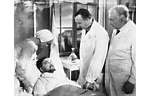
Lieutenant Rjepkin (actor: Vladimír Borský) is lying on a hospital bed in the foreground. Three figures are standing over him: Nurse Mathilde (actor: Adina Mandlová) on the left, and doctors Šrám...
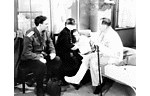
View of a hospital room. In the centre of the image, cadet Severa (actor: Stanislav Strnad) is lying on a bed and hugging his mother (actress: Marie Ptáková), who is sitting next to him. Rjepkin is ...
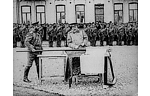
Hammering nails into flagpole of Czech legion and ceremonial blessing of the flag (28th September 1914) in Kiev.
O. Verf.. „Krieg und Kino.“ Der Kinematograph 397 (1914): 3-4. Bericht, wie bislang der Film in Kriegen eingesetzt worden sei. Ratschläge an Kinobesitzer, wie sie sich zu verhalten hätten. Mutma...
O. Verf.. „Mars regiert die Stunde.“ Der Kinematograph 397 (1914): 5-8. Aufruf an die Kinoindustrie, sich angesichts des Krieges in die Dienste des Vaterlandes zu stellen. Vorschlag, möglichst ak...
Mit der Kamera in der Schlachtfront.“ Der Kinematograph 397 (1914): 7. Werbeanzeige, die die Bedeutung der Filmaufnahmen gerade angesichts des drohenden Krieges hervorhebt.
Aubinger, Josef: „Die Kinematographie in Kriegszeiten.“ Der Kinematograph 398 (1914): 3-5. Artikel, der die mögliche Zukunft des Kinowesens im Krieg beschreibt. Die wirtschaftliche Lage der Kinos...
O. Verf.. „Schliesst die Kinos nicht.“ Der Kinematograph 399 (1914): 3-4. Aufruf an die Kinoindustrie, die Kinos nicht zu schließen, da das Volk in Kriegszeiten Ablenkung brauche. Die Eintrittspr...
Monopolfilm-Vertriebs-GmbH..“Patriotisches Kriegs-Programm.“ Der Kinematograph 399 (1914): 5. Werbung für das aktuelle Filmprogramm der Monopolfilm GmbH.
Asta-Nielsen-Lichtspiele GmbH. „Bismarck. Die neuesten Aufnahmen aus den Kriegstagen.“ Der Kinematograph 400 (1914): 1. Werbung, mit dem Hinweis, dass der Stoff des Filmes den ernsten Kriegstagen ...
O. Verf.. „Der Mangel an Aktualitäten.“ Der Kinematograph 400 (1914): 3-4. Artikel, der den Mangel an aktuellen Aufnahmen aus dem Krieg beklagt. Der Krieg sei die richtige Gelegenheit für die Pr...