The film is part of the election campaign for The Norwegian Labour Party in 1930 and argues against the militarism of the Conservative Party. Scenes from World War I illustrates the horrors of the war...
In January 1916 there was a great fire in Bergen, where almost 400 buildings burned down and 2700 people lost their homes. The film shows the clean-up of the ruins.
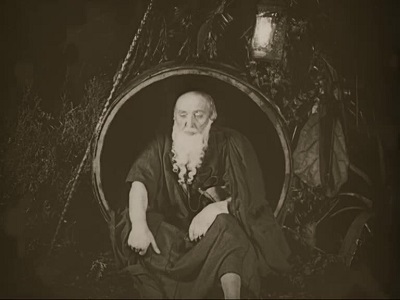
A commercial for Rex Margarine with the Greek philosopher Diogenes as the main character.
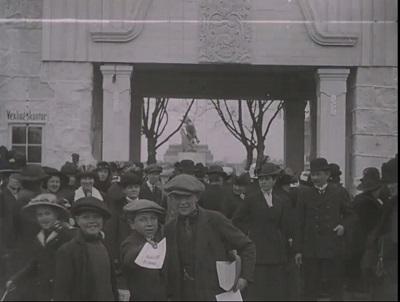
Various clips from Oslo 1912-14. The opening of the 100th Anniversary Exhibition, May 15, 1914, with people waiting to get in. Market stalls and trade in Oslo city centre. The departure of one of The ...
Newsreel showing the breakdown of the relation between USA and Germany in 1917, in addition to pictures from the American Navy, female train conductors and polar bears in a Paris zoo.
Newsreel in three parts: a football match with female players, the autumn fashion from Paris, and the favourite sport of cowboys, which seems to be gymnastics.
Commercial for Freia chocolates.
The film shows the visit of King Haakon 7th to the city of Sandefjord in 1916.
Celkový pohled do kavárny plné rakouských důstojníků. Někteří sedí u stolků a další stojí na pozadí, většina se skleničkami v ruce. Uprostřed vzadu stojí zdravostní sestra Mathil...
Celek pracovny, v níž za psacím stolem sedí MUDr. Šrámek (František Smolík) v rakouské důstojnické uniform a hledí na zdravotní sestru Mathilde (Adina Mandlová), stojící na druhé stra...
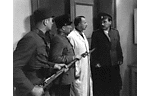
Polocelek stojícího rakouského vojáka, rakouského plukovníka (Jaroslav Marvan), MUDr. Šrámka (František Smolík) a poručíka Rjepkina (Vladimír Borský), na něhož je namířená puška s ...
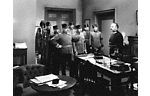
Celek pracovny, v níž u dveří stojí skupina sedmi rakouských důstojníků (pátý zleva Jaroslav Marvan) a hledí na MUDr. Šrámka (František Smolík), stojícího za pracovním stolem. Jeden...
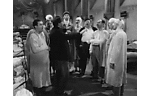
Celek nemocničního pokoje, v němž stojí skupinka pacientů a tři vojíni. Jeden z vojínů, pěšák Tlamicha (Theodor Pištěk), stojí uprostřed a diriguje, ostatní zpívají (šestý zprava...
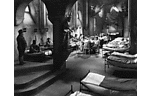
Celkový pohled do interiéru kostela, přebudovaného na vojenský lazaret. Po stranách jsou umístěná nemocniční lůžka, na nichž sedí a leží ranění vojáci. V chodbičce uprostřed stoj...
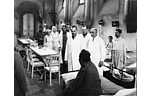
Celek nemocničního pokoje, kde probíhá vizita. Nalevo stojí stoly s karafou s vodou a chlebem. Kolem stolů jsou postavené židle. Uprostřed místnosti stojí pět lékařů, za nimi dvě zdrav...
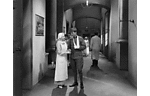
Celek nemocniční chodby, uprostřed níž stojí ošetřovatelka Tonička (Truda Grosslichtová) a drží se za ruku s kaprálem Bartoňkem (Jiří Vondrovič), který má druhou ruku v sádře. Dvo...
Der Kampf gegen die deutschfeindliche ausländische Kinoindustrie, Bild & Film. Zeitschrift für Lichtbilderei und Kinematographie, IV,1, (1914/1915), S. 9-11. Die deutsche Filmbranche sei noch immer ...
Rundschau, Bild & Film. Zeitschrift für Lichtbilderei und Kinematographie, IV,1, (1914/1915), S. 34-41. Berichte über Firmen, die mit Pathé Frères in Verbindung stünden und deshalb boykottiert we...
F. Felix, Krieg den Kriegsdramen, Bild & Film. Zeitschrift für Lichtbilderei und Kinematographie, IV, 4/5, (1914/1915), S. 91-93. Polemik gegen die Verarbeitung der Kriegsereignisse im Film und gegen...
Dr. Willi Warstatt, Der patriotische Film, wie er ist und wie er sein könnte, Bild & Film. Zeitschrift für Lichtbilderei und Kinematographie, IV,6, (1914/1915), S. 109-111. Bisherige patriotische Fi...
L. Hamburger, Kriegsdramen, Bild & Film. Zeitschrift für Lichtbilderei und Kinematographie, IV,6, (1914/1915), S. 119. Die neu entstandene Gattung des Kriegsfilms zeichne sich durch übelsten Kitsch ...
Hermann Häfker, Berliner Höhe, Bild & Film. Zeitschrift für Lichtbilderei und Kinematographie, IV,6, (1914/1915), S. 127-129. Das Kino sei auf einem Tiefpunkt angelangt. Kriegsfilme wie der besproc...
Will Scheller, Über den Einfluss des Krieges auf die Filmkunst in Deutschland, Bild & Film. Zeitschrift für Lichtbilderei und Kinematographie, IV,10, (1914/1915), S. 197-200. Der Krieg habe die Film...
B.Z., Rattenfilme, Bild & Film. Zeitschrift für Lichtbilderei und Kinematographie, IV, 10, (1914/1915), S. 205-207. Bericht über Propagandafilme der Kriegsgegner.