(Reel 21) The episode starts with 'Justice' and captioned newspaper clippings, "British forces in peril... more important than Kut". The decision to send the relief force on 4th April 1919 is reported...
The first third of the film is badly jumbled and shows repeated shots of the naval contingent (including the Royal Marines) led by Admiral Sir David Beatty, passing through Admiralty Arch and about to...
I. The film contrasts quotes from a German newspaper given as 'Westphalia Daily News' reporting the damage or destruction of prominent landmarks in the centre of London with film of those places taken...
(Reel 1) Partly through the limitations imposed on the filming of Japanese royalty and inside the various palaces, this film shows virtually nothing of the official ceremonies. The first half concentr...
Damage in the Roye-Soissons area, showing many of the smaller towns and villages. Destroyed fruit trees. A desecrated cemetery at Tergnier. Damaged houses at Coucy-la-Ville and Coucy-le-Château. The ...
I. A recruiting march by girls of the Women's Land Army in central London, April 1918. Members of the Women's Land Army form an escort for the Lord Mayor of London, Charles A Hanson, as he enters Sain...
(Reel 1) The departure of the Archduke (later Emperor) Karl with General Conrad von Hötzendorf from Vienna to inspect Austrian troops in the Tyrolean region, close to the Italian Front. Outside a hun...
The rail station at Châtel-Chéhéry near the Aisne on 11th October 1918 showing the limit of the German advance to Paris. A view of the town itself two days later. German prisoners of war at a camp ...
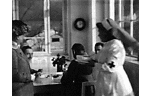
Wounded soldiers eat in a hospital room.
A military doctor shows a wounded soldier to a Red Cross delegation.
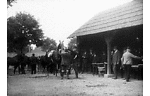
Requisition of horses.
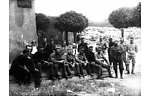
Conscripts in the assembly camp.
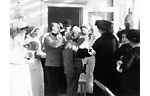
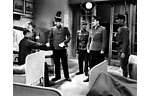
Wide shot of a hospital room. A standing First Lieutenant Schranel (actor: Vladimír Pospíšil-Born) shakes hands with First Lieutenant Liška (actor: František Kreuzmann), who is sitting on a bed w...
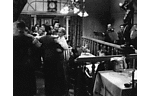
View of a dance café. Several couples are dancing on the left, including First Lieutenant Schranel (actor: Vladimír Pospíšil-Born) and Nurse Mathilde (actress: Adina Mandlová). To the right of th...
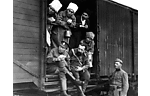
Exterior view of a train. Six Russian soldiers (prisoners of war) with Asian features are sitting or standing in the train's open door. Some of the soldiers are holding bread in their hands and all ar...
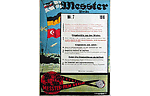
Der Kampf gegen die deutschfeindliche ausländische Kinoindustrie, Bild & Film. Zeitschrift für Lichtbilderei und Kinematographie, IV,1, (1914/1915), S. 9-11. Die deutsche Filmbranche sei noch immer ...
Rundschau, Bild & Film. Zeitschrift für Lichtbilderei und Kinematographie, IV,1, (1914/1915), S. 34-41. Berichte über Firmen, die mit Pathé Frères in Verbindung stünden und deshalb boykottiert we...
F. Felix, Krieg den Kriegsdramen, Bild & Film. Zeitschrift für Lichtbilderei und Kinematographie, IV, 4/5, (1914/1915), S. 91-93. Polemik gegen die Verarbeitung der Kriegsereignisse im Film und gegen...
Dr. Willi Warstatt, Der patriotische Film, wie er ist und wie er sein könnte, Bild & Film. Zeitschrift für Lichtbilderei und Kinematographie, IV,6, (1914/1915), S. 109-111. Bisherige patriotische Fi...
L. Hamburger, Kriegsdramen, Bild & Film. Zeitschrift für Lichtbilderei und Kinematographie, IV,6, (1914/1915), S. 119. Die neu entstandene Gattung des Kriegsfilms zeichne sich durch übelsten Kitsch ...
Hermann Häfker, Berliner Höhe, Bild & Film. Zeitschrift für Lichtbilderei und Kinematographie, IV,6, (1914/1915), S. 127-129. Das Kino sei auf einem Tiefpunkt angelangt. Kriegsfilme wie der besproc...
Will Scheller, Über den Einfluss des Krieges auf die Filmkunst in Deutschland, Bild & Film. Zeitschrift für Lichtbilderei und Kinematographie, IV,10, (1914/1915), S. 197-200. Der Krieg habe die Film...
B.Z., Rattenfilme, Bild & Film. Zeitschrift für Lichtbilderei und Kinematographie, IV, 10, (1914/1915), S. 205-207. Bericht über Propagandafilme der Kriegsgegner.