(Reel 21) The episode starts with 'Justice' and captioned newspaper clippings, "British forces in peril... more important than Kut". The decision to send the relief force on 4th April 1919 is reported...
The first third of the film is badly jumbled and shows repeated shots of the naval contingent (including the Royal Marines) led by Admiral Sir David Beatty, passing through Admiralty Arch and about to...
I. The film contrasts quotes from a German newspaper given as 'Westphalia Daily News' reporting the damage or destruction of prominent landmarks in the centre of London with film of those places taken...
(Reel 1) Partly through the limitations imposed on the filming of Japanese royalty and inside the various palaces, this film shows virtually nothing of the official ceremonies. The first half concentr...
Damage in the Roye-Soissons area, showing many of the smaller towns and villages. Destroyed fruit trees. A desecrated cemetery at Tergnier. Damaged houses at Coucy-la-Ville and Coucy-le-Château. The ...
I. A recruiting march by girls of the Women's Land Army in central London, April 1918. Members of the Women's Land Army form an escort for the Lord Mayor of London, Charles A Hanson, as he enters Sain...
(Reel 1) The departure of the Archduke (later Emperor) Karl with General Conrad von Hötzendorf from Vienna to inspect Austrian troops in the Tyrolean region, close to the Italian Front. Outside a hun...
The rail station at Châtel-Chéhéry near the Aisne on 11th October 1918 showing the limit of the German advance to Paris. A view of the town itself two days later. German prisoners of war at a camp ...
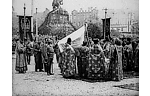
Ceremonial blessing of the flag (28th September 1914) of Czech legion in Kiev.
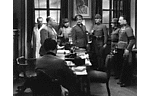
Wide shot of an office. Standing from left to right are: Dr. Šrámek (actor: František Smolík), an Austrian colonel (actor: Jaroslav Marvan), a military guard, Lieutenant Rjepkin (actor: Vladimír ...
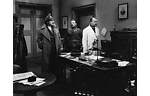
Wide shot of an officer. Lieutenant Rjepkin (actor: Vladimír Borský) is standing on the left. Dr. (actor: František Smolík) is standing behind a desk on the right with his back to Rjepkin. An Aust...
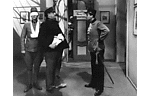
Wide shot of a corridor. Corporal Bartoněk (actor: Jiří Vondrovič) is standing on the right with an arm in a cast and bandaged eyes. Infantryman Tlamicha (actor: Theodor Pištěk) is standing next...
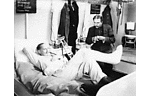
First Lieutenant Liška (actor: František Kreuzmann) is lying on a hospital bed with his leg in a cast and smoking. An Austrian officer is sitting to the right of him and peeling something. In the ba...
O. Verf.. „Krieg und Kino.“ Der Kinematograph 397 (1914): 3-4. Bericht, wie bislang der Film in Kriegen eingesetzt worden sei. Ratschläge an Kinobesitzer, wie sie sich zu verhalten hätten. Mutma...
O. Verf.. „Mars regiert die Stunde.“ Der Kinematograph 397 (1914): 5-8. Aufruf an die Kinoindustrie, sich angesichts des Krieges in die Dienste des Vaterlandes zu stellen. Vorschlag, möglichst ak...
Mit der Kamera in der Schlachtfront.“ Der Kinematograph 397 (1914): 7. Werbeanzeige, die die Bedeutung der Filmaufnahmen gerade angesichts des drohenden Krieges hervorhebt.
Aubinger, Josef: „Die Kinematographie in Kriegszeiten.“ Der Kinematograph 398 (1914): 3-5. Artikel, der die mögliche Zukunft des Kinowesens im Krieg beschreibt. Die wirtschaftliche Lage der Kinos...
O. Verf.. „Schliesst die Kinos nicht.“ Der Kinematograph 399 (1914): 3-4. Aufruf an die Kinoindustrie, die Kinos nicht zu schließen, da das Volk in Kriegszeiten Ablenkung brauche. Die Eintrittspr...
Monopolfilm-Vertriebs-GmbH..“Patriotisches Kriegs-Programm.“ Der Kinematograph 399 (1914): 5. Werbung für das aktuelle Filmprogramm der Monopolfilm GmbH.
Asta-Nielsen-Lichtspiele GmbH. „Bismarck. Die neuesten Aufnahmen aus den Kriegstagen.“ Der Kinematograph 400 (1914): 1. Werbung, mit dem Hinweis, dass der Stoff des Filmes den ernsten Kriegstagen ...
O. Verf.. „Der Mangel an Aktualitäten.“ Der Kinematograph 400 (1914): 3-4. Artikel, der den Mangel an aktuellen Aufnahmen aus dem Krieg beklagt. Der Krieg sei die richtige Gelegenheit für die Pr...