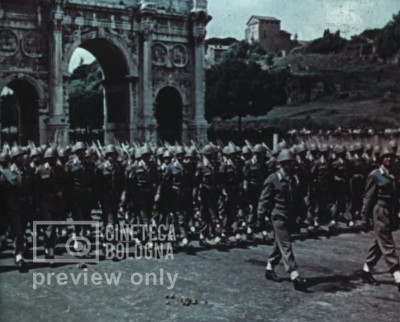
The history and life of the military corps the Grenadiers of Sardinia.
Strade di Cettigne, capitale del Regno del Montenegro. Il Palazzo dei Ministri e delle Regie Poste. Il nuovo palazzo della Legazione Italiana. Il Teatro Reale. Il Palazzo Reale. Nicola I, Re del...
The film reviews the history and art of Vienna and the empire of which it was the capital for centuries, ending with a vision of the contemporary city.
Marinetti, definito da Boccioni “poeta e impresario”, dopo la pubblicazione del primo manifesto futurista su “Le Figaro” (1909) diffonde il Manifesto tecnico della letteratura futurista,...
Špilberk is a picturesque castle dominating the modern city of Brno (Czech Republic). Over the course of time it has been a fortress, prison, museum and a place for torture. During the Inquisit...
La voce fuori campo, con accento dialettale, è quella di un emigrato del sud Italia in America, che racconta come la prima cosa che all'estero si rimpiange della madrepatria sia l'olio. Si vede...
01 – Cinema (Roma, 16/11/1976) Sulle pagine di alcuni quotidiani, articoli che parlano della crisi che sta attraversando il cinema italiano. L'attrice Agostina Belli, sul set cinematografico, ...
Ricostruzione degli eventi principali della prima guerra mondiale, con particolare attenzione alle vicende italiane, un largo utilizzo di grafici, cartine, illustrazioni, fotografie, e il freque...
Girl and boy in folk costumes embrace each other on the meadow. Behind them stands the President of the Czechoslovak Republic Tomáš Garrigue Masaryk.
Student Jiří Voldán, after the mobilisation order of 1914, is called up to serve in the Austro-Hungarian army to fight against Russia. With his Czech and Slovak compatriots, he decides to cross to ...
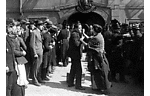
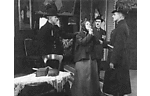
A group of civilians and policemen. In the middle stands infantryman Kubík (actor: Václav Kubásek) on suit. Next to Kubík stands a woman on skirt and shawl.
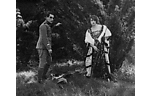
Jiří Voldán (actor: Vladimír Ch. Vladimírov) and his fiancée Maryša (actress: Suzanne Marwille) with the rifle.
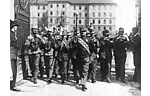
Austrian military band
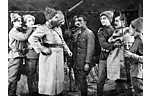
A group of Russian soldiers with fur hats, rifles and bayonets.
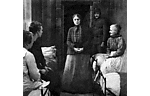
Mother of Jiří Voldán (actress: Marie Ptáková) in the female prison. Another women sit on the bed. At the door stands a soldier.
Mother of Jiří Voldán (actress: Marie Ptáková) between two policemen in uniforms. Behind her stands secret policeman.
Das Königliche Bild-und Filmamt und die Industrie, Der Kinematograph, 571, (1917). S. 22ff. Artikel über Verhandlungen des Bild-und Filmamtes mit Vertretern der Filmindustrie. Bufa zeige sich am Woh...
Walter Thielemann, Der Film 1917, Der Kinematograph, 573, (1917), S. 12ff. Jahresrückblick. Positiv hervorgehoben wird die immer breitere Anerkennung, die dem Kino zuteil werde, da der immer mehr sei...
Scala-Film-Verleih GmbH, Der Hetman der Ukraine, Der Kinematograph, 581, (1918), S. 18-19. Die Anzeige geht auf den Sieg gegen Russland ein und erwähnt das Interesse des Publikums an der Geschichte d...
Argus, Neuheiten auf dem Berliner Filmmarkte, Der Kinematograph, 581, (1918), S. 28-29. "Edelsteine" wird als erstes besprochen und als psychologisch tiefgründiges Werk bezeichnet. An dritter Stelle ...
Argus, Der rasende Roland von Euskirchen, Der Kinematograph, 582, (1918), S. 6. Entgegnung auf Vorwürfe des Euskirchener Volksblattes, das Kino sei sittenverderbend. Der Schriftleiter Werner Rats kö...
Argus, Neuheiten auf dem Berliner Filmmarkte, Der Kinematograph, 586, (1918), S. 28ff. Besprochen werden gleich zwei Propagandafilme zur achten Kriegsanleihe. "Lloyd George in Berlin" wird als äußer...
Julius Sternheim, Propaganda-und Aufklärungsfilme, Der Kinematograph, 592, (1918), S. 12-14. Propagandafilme müssten maßgeblich eine Botschaft verfolgen, was sie oftmals zwangsläufig langatmig mac...
Ludwig Brauner, Die kommende Geschmackswandlung, Der Kinematograph, 593, (1918), S. 15-16. Erörterung des Publikumsgeschmacks. Gegenwärtig sei vor allem Ablenkung vom Kriegsalltag gefragt, jedoch li...