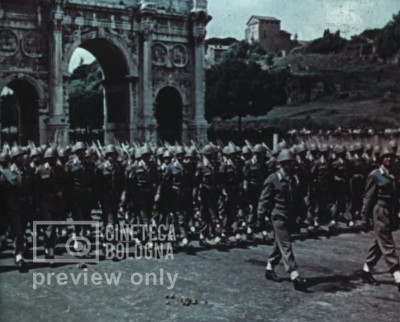
The history and life of the military corps the Grenadiers of Sardinia.
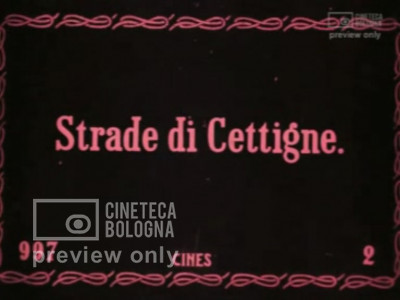
Strade di Cettigne, capitale del Regno del Montenegro. Il Palazzo dei Ministri e delle Regie Poste. Il nuovo palazzo della Legazione Italiana. Il Teatro Reale. Il Palazzo Reale. Nicola I, Re del...
The film reviews the history and art of Vienna and the empire of which it was the capital for centuries, ending with a vision of the contemporary city.
Marinetti, definito da Boccioni “poeta e impresario”, dopo la pubblicazione del primo manifesto futurista su “Le Figaro” (1909) diffonde il Manifesto tecnico della letteratura futurista,...
Špilberk is a picturesque castle dominating the modern city of Brno (Czech Republic). Over the course of time it has been a fortress, prison, museum and a place for torture. During the Inquisit...
La voce fuori campo, con accento dialettale, è quella di un emigrato del sud Italia in America, che racconta come la prima cosa che all'estero si rimpiange della madrepatria sia l'olio. Si vede...
01 – Cinema (Roma, 16/11/1976) Sulle pagine di alcuni quotidiani, articoli che parlano della crisi che sta attraversando il cinema italiano. L'attrice Agostina Belli, sul set cinematografico, ...
Ricostruzione degli eventi principali della prima guerra mondiale, con particolare attenzione alle vicende italiane, un largo utilizzo di grafici, cartine, illustrazioni, fotografie, e il freque...
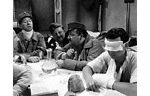
Medium shot of several men sitting around a table with a half loaf of bread and a carafe of water. On the left sits Sakař (actor: Jindřich Plachta) with a bandaged neck. To the right sit Vyskočil (...
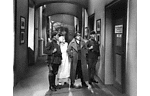
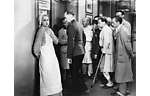
Wide shot of a corridor. Standing in front of the door to Dr. Šrámek's office are Nurse Mathilde (actress: Adina Mandlová) and Rjepkin (actor: Vladimír Borský) flanked by Austrian military guards...
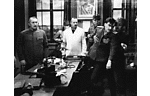
View of an office. A colonel of the Austrian army (actor: Jaroslav Marvan) and Dr. Šrámek (actor: František Smolík) are standing at a desk. Behind Šrámek are two military guards (on the right, a...
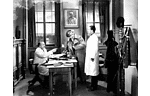
Wide shot of an office. Dr. Šrámek (actor: František Smolík) is sitting at a desk and pointing at another doctor standing on the opposite side of the desk. Rjepkin (actor: Vladimír Borský) is st...
Wide shot of a corridor and a door with a sign indicating "MUDr. Fr. Šrámek." Standing in front of the door are nurse Mathilde (actress: Adina Mandlová), First Lieutenant Liška (actor: František ...
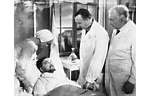
Lieutenant Rjepkin (actor: Vladimír Borský) is lying on a hospital bed in the foreground. Three figures are standing over him: Nurse Mathilde (actor: Adina Mandlová) on the left, and doctors Šrám...
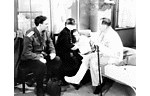
View of a hospital room. In the centre of the image, cadet Severa (actor: Stanislav Strnad) is lying on a bed and hugging his mother (actress: Marie Ptáková), who is sitting next to him. Rjepkin is ...
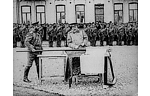
Hammering nails into flagpole of Czech legion and ceremonial blessing of the flag (28th September 1914) in Kiev.
Oscar Geller, Detektiv-Filme, Der Kinematograph, 593, (1918), S. 21-25. Eröterung der Krimiwelle. Man könne Krimis nicht einfach als Schund abtun. Auch wenn viele der frühen Krimis, maßgeblich aus...
Poldi Schmidl, Der Kinobesitzer als Staatsbeamter, Der Kinematograph, 607, (1918). Angesichts der geplanten Konzessionspflicht für Kinobesitzer wird die Möglichkeit einer Verstaatlichung der Filmind...
Argus, Neuheiten auf dem Berliner Filmmarkte, Der Kinematograph, 614, (1918). "Kinder der Liebe" als Tendenz- und Aufklärungsfilm bezeichnet, dessen Absicht überzeuge. "Der Gefangene von Dahomey" se...
Egon Jacobsohn, Ferdinand Lassalle, Der Kinematograph, 615, (1918), S. 18-30. Bericht von der Uraufführung in Berlin. Die Aufführung sei ein voller Erfolg gewesen, zumal es besonders gut in die Zeit...
Deutsche Lichtbild Gesellschaft e.V., Der Friedensreiter, Der Kinematograph, 618, (1918), S.22-23.
Emil Perlmann, Wenn die Waffen ruhen...!, Der Kinematograph, 619, (1918). Erörterung der Lage der Filmindustrie angesichts des greifbaren Kriegsendes. Die Filmindustrie müsse den Kampf gegen die Zen...
Der deutsche Film für das Ausland, Der Kinematograph, 620, (1918). Es sei Aufgabe der deutschen Filmindustrie, den negativen Vorstellungen über Deutschland, die im Ausland im Krieg verbreitet worden...
Universum Filmverleih, Die Waffen nieder, Der Kinematograph, 620, (1918), S. 28-33.