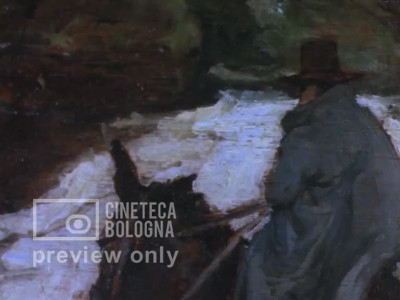
Livorno was just a lively center of Macchiaioli art as Florence. Many artists painted in Livorno including Cristiano Banti, Giovanni Boldini and, on the most painted waterfront in Italy, Vincenz...
Il film, utilizzando materiali iconografici di repertorio, riprese sui luoghi reali e ricostruzioni narrative in assenza di personaggi, rievoca gli episodi più significativi della seconda guerr...
The work and the life of the writer Giovanni Boine.
Some moments of Umberto Saba’s poetry.
Si ricostruisce la vita di Giuseppe Melchiorre Sarto (1835-1914), nominato papa nel 1903, attraverso fotografie e immagini dei luoghi in cui visse. La prima parte è dedicata a Riese, in provinc...
The documentary reconstructs World War I through the letters of fighting soldiers. Both the situations in Italy and in other warring nations are taken into consideration.
Until today one of the most mysterious figures in Italian cinema has been, without a doubt, Lucio D’Ambra. Recent finds of his works permit a more accurate outline of a personality capable of ...
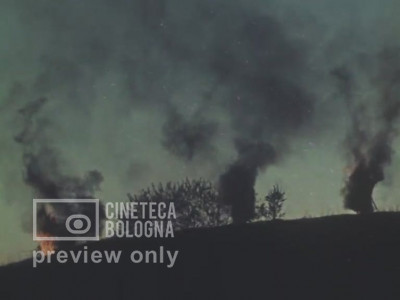
An evening at winter’s end: in Veneto, in the countryside of Treviso (in Zero Branco) the farmers have prepared bonfires for the feast of bread and wine, a propitiatory rite for a good year. T...
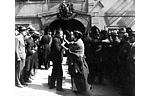
A group of civilians and policemen. In the middle stands infantryman Kubík (actor: Václav Kubásek) on suit. Next to Kubík stands a woman on skirt and shawl.
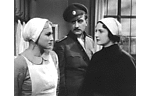
Medium close-up of Nurse Mathilde (actress: Adina Mandlová), Lieutenant Rjepkin (actor: Vladimír Borský) in uniform, and his wife Lída (actress: Marie Rosůlková). The women are looking at each o...
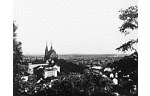
Panorama of the city of Brno (one of the film's settings) with the cathedral of Saints Peter and Paul on the horizon.
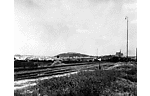
Panorama of the city of Brno (one of the film's settings) with a railway station in the foreground and the top of Špilberk castle on the horizon. The cathedral of Saints Peter and Paul protrudes up o...
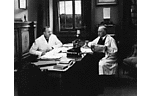
View of a doctor's office. Dr. Šrámek (actor: František Smolík) sits at a desk and Dr. Klíma (actor: Karel Veverka) sits opposite him with the newspaper Národní politika in his hand. On the des...
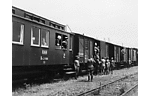
Wide shot of a standing train occupied by Russian officers and regular soldiers. A group of Austrian soldiers stands in front of the train. Several of them are wearing armbands of the Red Cross.
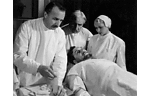
Medium shot of an operating room. Dr. Šrámek (actor: František Smolík) stands on the left with a syringe in his hand. Next to him are Dr. Klíma (actor: Karel Veverka) and Nurse Tonička (actress:...
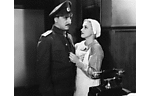
Medium shot of Lieutenant Rjepkin (actor: Vladimír Borský) and Nurse Mathilde (actress: Adina Mandlová) standing in a small room. The nurse is in uniform and holds the button on Rjepkin's coat. In ...
Das Königliche Bild-und Filmamt und die Industrie, Der Kinematograph, 571, (1917). S. 22ff. Artikel über Verhandlungen des Bild-und Filmamtes mit Vertretern der Filmindustrie. Bufa zeige sich am Woh...
Walter Thielemann, Der Film 1917, Der Kinematograph, 573, (1917), S. 12ff. Jahresrückblick. Positiv hervorgehoben wird die immer breitere Anerkennung, die dem Kino zuteil werde, da der immer mehr sei...
Scala-Film-Verleih GmbH, Der Hetman der Ukraine, Der Kinematograph, 581, (1918), S. 18-19. Die Anzeige geht auf den Sieg gegen Russland ein und erwähnt das Interesse des Publikums an der Geschichte d...
Argus, Neuheiten auf dem Berliner Filmmarkte, Der Kinematograph, 581, (1918), S. 28-29. "Edelsteine" wird als erstes besprochen und als psychologisch tiefgründiges Werk bezeichnet. An dritter Stelle ...
Argus, Der rasende Roland von Euskirchen, Der Kinematograph, 582, (1918), S. 6. Entgegnung auf Vorwürfe des Euskirchener Volksblattes, das Kino sei sittenverderbend. Der Schriftleiter Werner Rats kö...
Argus, Neuheiten auf dem Berliner Filmmarkte, Der Kinematograph, 586, (1918), S. 28ff. Besprochen werden gleich zwei Propagandafilme zur achten Kriegsanleihe. "Lloyd George in Berlin" wird als äußer...
Julius Sternheim, Propaganda-und Aufklärungsfilme, Der Kinematograph, 592, (1918), S. 12-14. Propagandafilme müssten maßgeblich eine Botschaft verfolgen, was sie oftmals zwangsläufig langatmig mac...
Ludwig Brauner, Die kommende Geschmackswandlung, Der Kinematograph, 593, (1918), S. 15-16. Erörterung des Publikumsgeschmacks. Gegenwärtig sei vor allem Ablenkung vom Kriegsalltag gefragt, jedoch li...