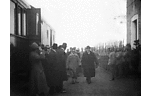
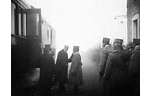
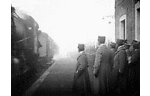
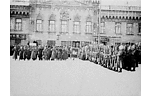
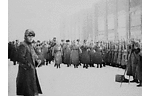
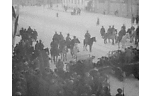
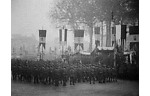
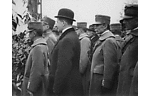
(Reel 1) King George V and General Sir Herbert Plumer, commanding Second Army to which the two divisions were attached, are greeted by 30th (Old Hickory) Division commander, Major-General Edward M Lew...
The film is partially completed, and shows some signs of proper editing, but scenes may break off abruptly in one reel and resume in another reel. Throughout the film numerous reporters, press photogr...
1915. május 30-án, vasárnap, a Szent Jobb megtalálásának emléknapján először (1) érkezett Pestre az ereklye. (2) A processziót a Katholikus Népszövetség (3) rendezte, a több száz tag...
Balogh András földműves leánya, Juli megszédül a cirkusz világától, titokban elhagyja faluját, s a táncmesterrel egy fővárosi mulatóba szerződik. Csábítója éjszaka is táncgyakorlat...
(Reel 1) The film opens with unrelated scenes of the Western Front, mainly the Marne and Château-Thierry areas. Then Theodore Roosevelt beside the grave of his son Quentin. Behind-the-lines scenes of...
The film emphasises the pre-war uniqueness of Britain, rich, insular, with a strong trading position and a free democracy united under the constitutional monarchy. The only pre-war violence comes in t...
(Reel 1) Training the New Army - "cheery non-slackers" undergo PT, drill and bayonet practice, mounting and sabre drill for cavalry. (Reel 2) Manufacture of a 15-inch naval gun and firing trials. (Ree...
Gáthy Lőrinc (a horvát verzióban: Mr. Wickfield) felesége meghal gyermekágyban. Egy nőrokona ajánlkozik, hogy gondját viseli az árván maradt gyermeknek és a háztartásnak, de Gáthy vissz...
Tomáš Garrigue Masaryk met the king of Italy Vittorio Emanuele III. di Savoia in Batavia.
General Štefánik on the visit of the Czechoslovak army in Jekaterinburg. Ceremonial handover of the flag.
General Štefánik on the visit of the Czechoslovak army in Jekaterinburg. On his right side general Jan Syrový.
General Štefánik on the visit of the Czechoslovak army in Jekaterinburg.
Regiments of Czechoslovak volunteers in Padova swear to the flegs with the participation of the Italian king Vittorio Emanuele III. di Savoia and Czech political representation.
O. Verf.. „Ein Kinematographengesetz in Württemberg.“ Bild & Film. Zeitschrift für Lichtbilderei und Kinematographie, III, 3/4 (1913/1914): 73. Jeder Film, der öffentlich vorgeführt werde, mü...
O. Verf.. „Kino und Kirche.“ Bild & Film. Zeitschrift für Lichtbilderei und Kinematographie III, 3/4 (1913/1914): 73-74. Beschlüsse der Fuldaer Bischofskonferenz von 20.8.1913. Schulpflichtigen ...
Felix, F.. „Die Kinematographie der Töne.“ Bild & Film. Zeitschrift für Lichtbilderei und Kinematographie III, 3/4 (1913/1914): 78-79. Meldung über erste Versuche, Film-und Tonaufnahmen zu sync...
W.R.. „Historische Filme.“ Bild & Film. Zeitschrift für Lichtbilderei und Kinematographie III, 3/4 (1913/1914): 86. Der Rezensent führt den Film als Beispiel dafür an, dass die Filmindustrie mi...
Hellwig, Albert. „Die Plakatzensur in Preussen.“ Bild & Film. Zeitschrift für Lichtbilderei und Kinematographie III,5 (1913/1914): 104-106. Rekapitulierung der Rechtslage zu Filmplakaten.
O. Verf.. „Preußischer Ministerialerlaß über das Plakat- und Reklamewesen.“ Bild & Film. Zeitschrift für Lichtbilderei und Kinematographie III, 5 (1913/1914): 111-112. Filmplakate bedürfen de...
Warstat, W.. „Kino und Schule. Von Prof. Dr. A. Sellmann.“ Bild & Film. Zeitschrift für Lichtbilderei und Kinematographie III,5 (1913/1914): 116-117. Der Rezensent sieht die Verwendung von Filmen...
Fritze, G.A.. „Die Kinematographie im Dienste der Industrie.“ Bild & Film. Zeitschrift für Lichtbilderei und Kinematographie III,6 (1913/1914): 124-128. Erörterung der bereits erfolgten Verwendu...